


Precision Oncology: How Tumour-Activated Prodrugs Are Redefining Cancer Therapy
By designing pharmacologically inactive compounds that undergo bio-activation exclusively within the tumour microenvironment, researchers are pushing the boundaries of selectivity, safety, and systemic exposure.
The fundamental challenge in cancer therapeutics remains unchanged: how do we eradicate malignant cells without inflicting catastrophic damage on healthy tissue? While systemic cytotoxic drugs exploit the cytokinetic differences between rapidly dividing cancer cells and normal cells, their therapeutic window is notoriously narrow.
The next frontier in targeted drug development addresses this via Tumour-Activated Prodrugs (TAPs). By designing pharmacologically inactive compounds that undergo bio-activation exclusively within the unique biochemical landscape of the tumour microenvironment (TME), researchers are pushing the boundaries of selectivity, safety, and systemic exposure.
The Architecture of a Prodrug
Modern TAPs are engineered with three distinct domains:
The Trigger
A masking group that prevents the drug from interacting with systemic targets. Designed to be cleaved or modified by a specific TME stimulus.
The Linker
The structural bridge that rapidly deactivates the drug until the trigger is metabolised — subsequently snapping to release the active payload.
The Effector
The cytotoxic warhead or immune modulator that induces rapid cell death or immune activation once unleashed.
To achieve maximum efficacy, TAPs must also rely on the bystander effect. Because only a fraction of tumour cells may possess the necessary activating properties — owing to tumour heterogeneity — the activated effector must be capable of diffusing and killing adjacent, activation-incompetent cancer cells.
Core Mechanisms of Activation
Recent literature highlights several distinct physiological triggers being exploited to unlock these localised therapeutics.
Hypoxia-Activated Prodrugs (HAPs)
Rapid tumour growth consistently outpaces angiogenesis, resulting in poorly vascularised, hypoxic regions — highly resistant to conventional radiotherapy and chemotherapy. HAPs act as bioreductive agents: inert under normoxic conditions but reduced by enzymes such as nitroreductase (NTR), significantly overexpressed in aggressive solid tumours, in low-oxygen environments. Recent 2024–2025 clinical designs have focused on utilising NTR-activatable small molecules not only to deliver toxic payloads but also as theragnostic agents for simultaneous imaging and photodynamic therapy (PDT).
Enzyme and Protease Responsiveness
The TME is characterised by the dysregulation and overexpression of various proteases and enzymes used for matrix degradation and tumour invasion. A major advancement is the application of enzyme-responsive prodrugs in immuno-oncology. Potent immune modulators such as Toll-Like Receptor (TLR) agonists cause severe off-target inflammation when administered systemically. By utilising peptide linkers selectively cleaved by TME-specific proteases, release of immune modulators can be localised — driving localised tumour immunity and regression without triggering a systemic cytokine storm.
Exploiting Tumour Metabolism: The Iron-Reactive Approach
Cancer cells exhibit altered metabolic signatures, including an elevated demand for iron to sustain rapid DNA synthesis and mitochondrial respiration — resulting in an elevated "labile iron pool" within the TME. Breakthrough preclinical studies have introduced Fe(II)-reactive prodrug conjugates in which intrinsic cytotoxicity is masked until reaction with ferrous iron specific to cancer cells. Because normal tissue has tightly regulated, low levels of labile iron, these compounds exhibit vastly reduced off-target toxicity — permitting higher dosing levels and improved xenograft responses.
The Role of Nanomedicine in TAP Delivery
"The efficacy of small-molecule prodrugs is often limited by their pharmacokinetic profiles. Integrating TAPs with advanced delivery vehicles has revolutionised the field."
Integrating TAPs with advanced delivery vehicles — such as nano-encapsulation, polyunsaturated fatty acid conjugations, and targeted oral peptides — has transformed what is achievable. Prodrug-based nanomedicines allow for:
- Sustained ReleaseProtecting the prodrug from premature degradation in the bloodstream.
- Enhanced Permeability and Retention (EPR)Allowing nanoparticles to preferentially accumulate in the leaky vasculature of tumours.
- Complex CombinationsCo-delivering multiple synergistic prodrugs — for example, combining a chemotherapeutic with an immune-modulating TLR agonist — in a single unified formulation.
The paradigm is shifting from merely poisoning fast-growing cells to actively outsmarting the tumour's own microenvironment. As trigger precision improves and delivery systems are refined, the prospect of a truly localised, zero-collateral cancer therapy draws closer to clinical reality.
Precision in Motion: Nano-Encapsulation and Transdermal Delivery of Tumour-Activated Prodrugs
A highly engineered molecule is only as effective as its pharmacokinetic (PK) profile. The translation of TAPs from theoretical efficacy to clinical reality frequently hinges on formulation. If a prodrug is cleared too rapidly, highly protein-bound, or degrades systemically before reaching the tumour microenvironment (TME), the precision trigger is rendered useless.
To bypass these physiological hurdles, modern drug development is increasingly coupling TAP technology with advanced, engineered delivery systems. Two of the most promising frontiers are nano-encapsulation and specialised transdermal platforms.
The Pharmacokinetic Imperative
The primary goal of marrying a TAP with an advanced delivery vehicle is to manipulate its macroscopic distribution. A naked small-molecule TAP is at the mercy of systemic circulation, first-pass hepatic metabolism, and renal clearance. By integrating these molecules into sophisticated carrier systems, developers can effectively decouple the drug's intrinsic physicochemical properties from its systemic behaviour — allowing for tightly controlled, sustained release kinetics and optimised bioavailability.
Nano-Encapsulation: The Trojan Horse of Oncology
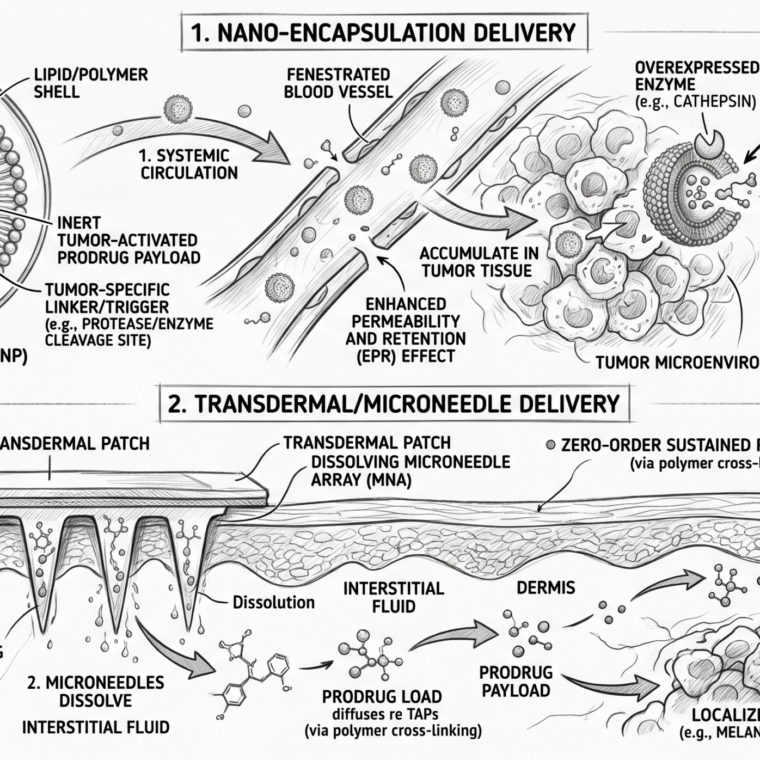
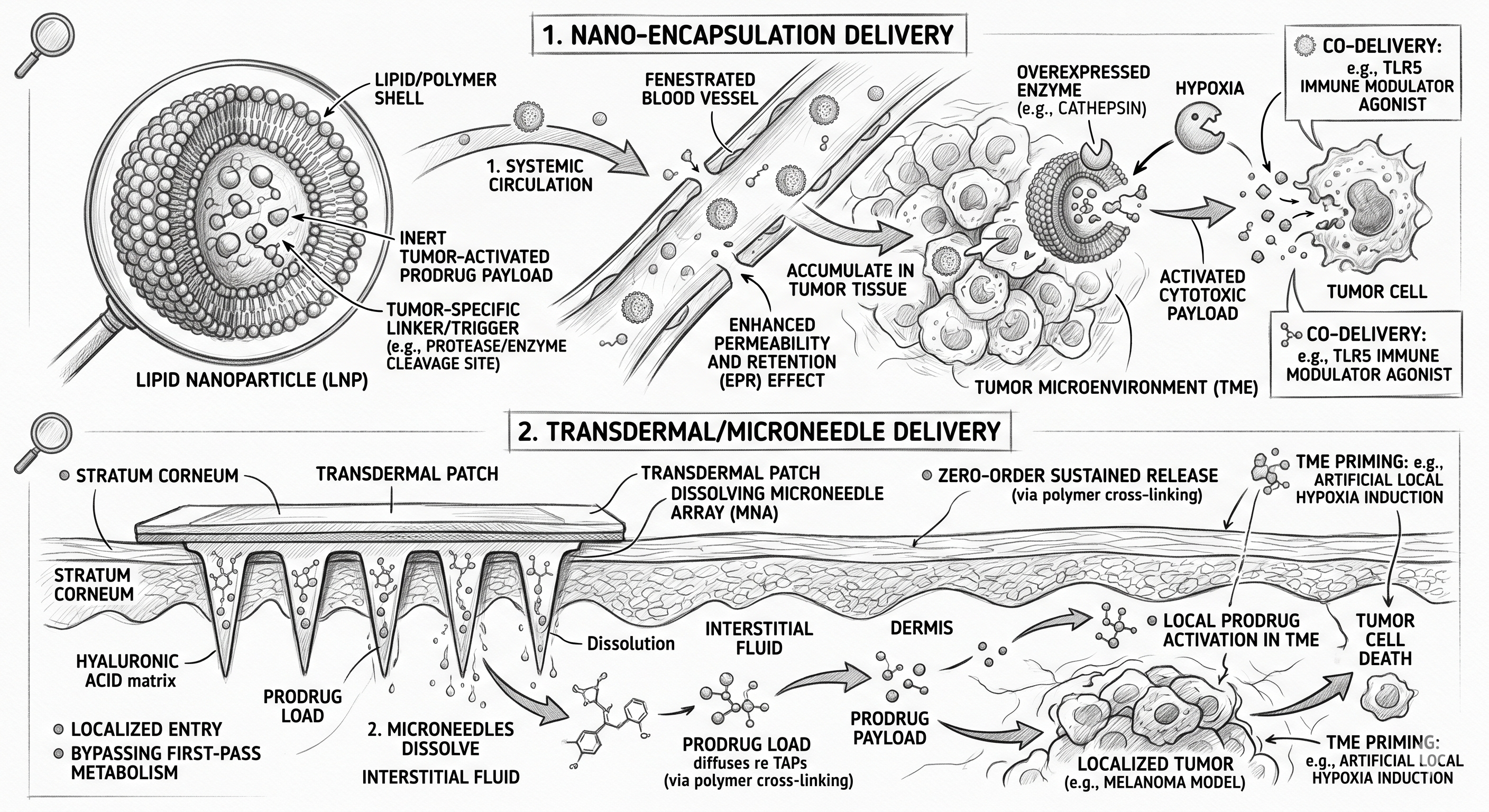
Nanomedicine radically alters the biodistribution of prodrugs. By utilising lipid nanoparticles (LNPs), liposomes, or polymeric micelles (typically in the 50–150 nm range), the TAP is shielded from premature enzymatic degradation in the bloodstream.
Exploiting the EPR Effect
Nano-encapsulated TAPs capitalise on the Enhanced Permeability and Retention (EPR) effect. Rapidly expanding solid tumours possess fenestrated, leaky vasculature and poor lymphatic drainage. Nanoparticles exploit this structural flaw, passively accumulating in the tumour bed at concentrations far exceeding what is achievable with free-floating drugs.
Co-Delivery and Synergistic Payloads
The most significant advantage of nano-encapsulation is the capacity for multiplexed delivery. The TME is highly immunosuppressive, and encapsulation allows for the simultaneous delivery of a cytotoxic TAP alongside a localised immune modulator.
Localised activation of innate immune pathways — such as through Toll-Like Receptor 5 (TLR5) signalling — is a potent method for flipping a "cold" tumour to "hot." By co-encapsulating a protease-cleavable TAP and a TLR5 agonist within a single liposomal vehicle, the payload remains entirely shielded in systemic circulation. Upon reaching the TME, localised proteases dismantle the nanoparticle matrix, initiating a localised immune cascade perfectly synchronised with the release of the cytotoxic effector.
Transdermal Platforms: Localised Entry, Sustained Control
Transdermal and localised epidermal delivery systems are being heavily researched for specific oncological applications, particularly in melanomas, superficial squamous cell carcinomas, and localised breast cancers.
Dissolving Microneedle Arrays (MNAs)
Traditional transdermal patches are limited by the stratum corneum, restricting absorption to molecules typically under 500 Da. Polymeric microneedle arrays bypass this barrier entirely — penetrating the epidermis and dissolving upon contact with interstitial fluid.
For TAP delivery, MNAs offer profound advantages:
| Advantage | Mechanism |
|---|---|
| Zero-Order Release Kinetics | By adjusting cross-linking density of the polymer matrix (e.g., hyaluronic acid or synthetic hydrogels), developers can achieve near-perfect steady-state release of the prodrug directly into regional lymphatic and capillary networks, bypassing first-pass metabolism entirely. |
| TME Priming | MNAs can be loaded with agents that actively manipulate the local environment to favour TAP activation — for example, co-delivering a localised hypoxia-inducing agent alongside a Hypoxia-Activated Prodrug (HAP) to artificially enhance the necessary TME trigger, guaranteeing bio-activation even in well-oxygenated superficial tumours. |
The era of administering free-floating cytotoxic agents is concluding. The future of targeted cancer therapy lies at the intersection of intricate molecular biology and advanced biophysical engineering. By utilising nano-encapsulation to navigate systemic circulation and exploring localised transdermal systems for direct-to-tumour delivery, we are building therapeutic platforms that dictate exactly where, when, and how a drug becomes active.