

Lawsone: From Natural Molecule to a
Next-Generation Antifibrotic Candidate
A naturally derived small molecule, long associated with cosmetic practice, is being redefined by modern pharmacology as a mechanistically novel candidate for fibrosis-driven liver disease — and potentially beyond.
Chemical Identity & Structure
A naphthoquinone scaffold with
far-reaching biological consequence
Lawsone (2-hydroxy-1,4-naphthoquinone) is a naturally occurring small molecule that has, for centuries, been associated more with cultural practice than clinical science. Derived primarily from the leaves of Lawsonia inermis (henna), this red-orange pigment has historically been used in cosmetics, textiles, and traditional medicine.
Modern pharmacological research is now redefining Lawsone as a molecule of significant biomedical interest, particularly in the context of liver disease and fibrosis biology. At a molecular level, it belongs to the 1,4-naphthoquinone family — a class of compounds known for their redox activity and biological versatility. Its chemical structure (C₁₀H₆O₃) comprises a quinone core with hydroxyl substitution, conferring both electrophilic reactivity and redox cycling capability.
Redox Modulation
Participates in electron transfer reactions, influencing oxidative stress pathways at a cellular level.
Protein Binding Affinity
Forms stable interactions with nucleophilic amino acid residues — explaining its use as a keratin dye and its biological reach.
Signalling Modulation
Quinone scaffolds modulate intracellular signalling cascades related to stress, inflammation, and proliferation.
Drug-Like Potential
Clinically relevant molecules such as atovaquone derivatives share structural links to naphthoquinone chemistry.
Natural Origin & Ethnomedicinal Context
Centuries of use;
a science only now catching up
Lawsone is the principal bioactive component of Lawsonia inermis, a plant deeply embedded in Ayurvedic, Unani, and traditional Middle Eastern medicine. Historically, henna preparations were used not only for cosmetic applications but also for wound healing, anti-inflammatory purposes, treatment of skin and infectious conditions, and support in certain liver-related disorders.
Modern phytochemical analyses confirm that henna contains a range of bioactive compounds — including flavonoids, tannins, and phenolic acids — that collectively exhibit antioxidant and hepatoprotective properties. While traditional medicine did not isolate Lawsone as a discrete therapeutic entity, contemporary science is now deconvoluting this complex botanical matrix, identifying it as a key driver of several observed biological effects.
Early Pharmacological Signals
Hepatoprotection and cytoprotection:
the early pharmacological signals
Before its emergence as an antifibrotic candidate, Lawsone was primarily investigated for its hepatoprotective potential. Preclinical studies demonstrated meaningful activity in hepatic systems under conditions of toxin-induced injury.
Hepatocellular protection
Reduction in hepatocellular injury in toxin-induced liver damage models, with restoration of cellular viability under drug-induced stress conditions.
Biochemical markers
Lowering of serum transaminases (ALT and AST) alongside decreased lipid peroxidation markers such as malondialdehyde (MDA).
Membrane stabilisation
In models of drug-induced liver injury (e.g., rifampicin–isoniazid toxicity), Lawsone restored cellular viability and significantly reduced enzyme leakage, suggesting direct antioxidant protection.
These early findings established two critical principles: that Lawsone is biologically active in hepatic systems, and that it exhibits a favourable safety window in preclinical settings. However, these studies framed Lawsone as a protective agent — not yet as a disease-modifying therapeutic.
The Paradigm Shift
From hepatoprotection to
direct antifibrotic biology
The most significant evolution in Lawsone research has occurred in recent years, where the focus has shifted from general hepatoprotection to direct modulation of fibrosis pathways. Liver fibrosis is fundamentally driven by the activation of hepatic stellate cells (HSCs), which transition into myofibroblast-like cells and produce excessive extracellular matrix proteins such as collagen — leading to progressive scarring, architectural distortion, and ultimately cirrhosis.
Recent studies have demonstrated that Lawsone exerts a constellation of antifibrotic effects:
- Suppresses α-smooth muscle actin (α-SMA) expression — a hallmark of stellate cell activation
- Reduces collagen (COL1A) production at the transcriptional level
- Induces cytoglobin (CYGB), a protein associated with antioxidant defence and stellate quiescence
- Disrupts cytoskeletal dynamics involved in fibrotic signalling
“Lawsone exerts these effects through inhibition of the YAP (Yes-associated protein) signalling pathway — a key regulator of mechanotransduction and fibrogenic gene expression.”
YAP is increasingly recognised as a central node in fibrosis biology, integrating mechanical cues, extracellular matrix stiffness, and intracellular signalling. Its activation is strongly associated with stellate cell activation, collagen deposition, and the persistence of the fibrotic phenotype. By reducing YAP activity, Lawsone effectively reprogrammes stellate cells away from a fibrogenic state — representing a fundamentally different therapeutic approach compared to traditional metabolic or anti-inflammatory strategies.

Lawsone (2-hydroxy-1,4-naphthoquinone): a naturally derived naphthoquinone that modulates YAP-mediated fibrogenesis and induces cytoglobin expression in hepatic stellate cells.
Preclinical Evidence
Evidence of fibrosis reversal
in preclinical models
Beyond cellular systems, Lawsone has demonstrated in vivo efficacy in established fibrosis models — which is particularly noteworthy given the historical difficulty of reversing fibrosis pharmacologically. In murine models of liver fibrosis, treatment with Lawsone led to significant reductions in collagen deposition, downregulation of key fibrotic markers including α-SMA and COL1A, increased cytoglobin expression suggesting restoration of cellular homeostasis, and a shift of stellate cells towards a more quiescent, non-fibrotic phenotype.
There are currently no widely approved therapies that directly reverse liver fibrosis. The ability of a small molecule to actively regress established fibrosis — rather than merely halt progression — positions Lawsone within a rare and highly valuable therapeutic category.
Mechanistic Depth
YAP, cytoglobin, and redox control:
a tripartite mechanism
YAP Signalling as a Central Fibrotic Switch
At the core of Lawsone’s antifibrotic activity lies its ability to modulate the YAP (Yes-associated protein) signalling pathway, a key effector of the Hippo pathway and a master regulator of mechanotransduction. In fibrotic liver tissue, increased extracellular matrix stiffness activates YAP, which translocates to the nucleus and drives transcription of fibrogenic genes such as COL1A1, ACTA2 (α-SMA), and CTGF — creating a self-reinforcing loop where fibrosis begets further fibrosis.
Lawsone interrupts this loop by reducing YAP protein stability, limiting its nuclear localisation, and disrupting the cytoskeletal organisation required for YAP activation. This positions Lawsone not as a general anti-inflammatory agent, but as a mechanotransduction modulator — a relatively underexplored but highly promising therapeutic axis.
Cytoglobin (CYGB): Restoring Stellate Quiescence
A second, equally important mechanism is the induction of cytoglobin (CYGB). Highly expressed in quiescent hepatic stellate cells and downregulated during fibrotic activation, CYGB plays a key role in oxygen homeostasis and reactive oxygen species (ROS) scavenging. Lawsone has been shown to upregulate CYGB expression, enhance antioxidant capacity within stellate cells, and promote reversion towards a quiescent phenotype.
“This dual action — suppressing activation signals (YAP) while restoring protective pathways (CYGB) — is particularly noteworthy, as most antifibrotic strategies focus on only one side of this equation.”
Redox Biology and Mitochondrial Modulation
As a quinone, Lawsone inherently interacts with cellular redox systems. Rather than acting purely as a pro-oxidant, it appears to modulate mitochondrial ROS production, reduce lipid peroxidation, and influence cellular stress signalling pathways. This aligns with emerging evidence that controlled redox modulation — rather than blanket antioxidant activity — is critical in diseases such as NASH, where mitochondrial dysfunction plays a central role.
Therapeutic Positioning
Positioning in NAFLD/NASH:
beyond metabolic correction
The current NASH therapeutic landscape has been dominated by agents targeting lipid metabolism, insulin resistance, and incretin pathways. These approaches have demonstrated clear benefits in reducing hepatic steatosis, improving metabolic parameters, and lowering cardiovascular risk. However, their impact on fibrosis regression — particularly in advanced disease (F2–F4) — remains variable, often modest, and slow to manifest.
This has led to a growing consensus that fibrosis is not merely a downstream consequence of metabolic dysfunction — it is a self-sustaining pathological process requiring direct intervention.
Lawsone addresses this gap by acting directly on hepatic stellate cells, collagen production, and ECM remodelling — enabling clear positioning in advanced NASH (F2–F4), in patients with residual fibrosis despite metabolic improvement, and as a component of combination regimens with metabolic agents.
| Disease Driver | Therapeutic Class | Example |
|---|---|---|
| Steatosis | THR-β / GLP-1 agonists | Resmetirom |
| Inflammation | Anti-inflammatory agents | Emerging |
| Fibrosis | Stellate-cell modulators | Lawsone |
In this model, Lawsone provides the missing pillar: direct fibrosis reversal. The future of NASH management is increasingly expected to resemble oncology or cardiometabolic care, where combination therapy becomes standard and each therapeutic addresses a distinct disease driver.
Formulation & Delivery
From molecule to medicine:
pharmaceutical optimisation
While the biological profile of Lawsone is compelling, successful translation depends heavily on pharmaceutical optimisation. Key challenges include moderate aqueous solubility, the potential for systemic redox activity at higher exposures, and the need for liver-targeted delivery to maximise efficacy and safety. These are tractable engineering problems — not fundamental limitations.
Prodrug Approaches (Hennosides)
Conjugation strategies may allow controlled release in hepatic tissue, reduced systemic exposure, and improved pharmacokinetics — potentially leveraging natural glycoside chemistries.
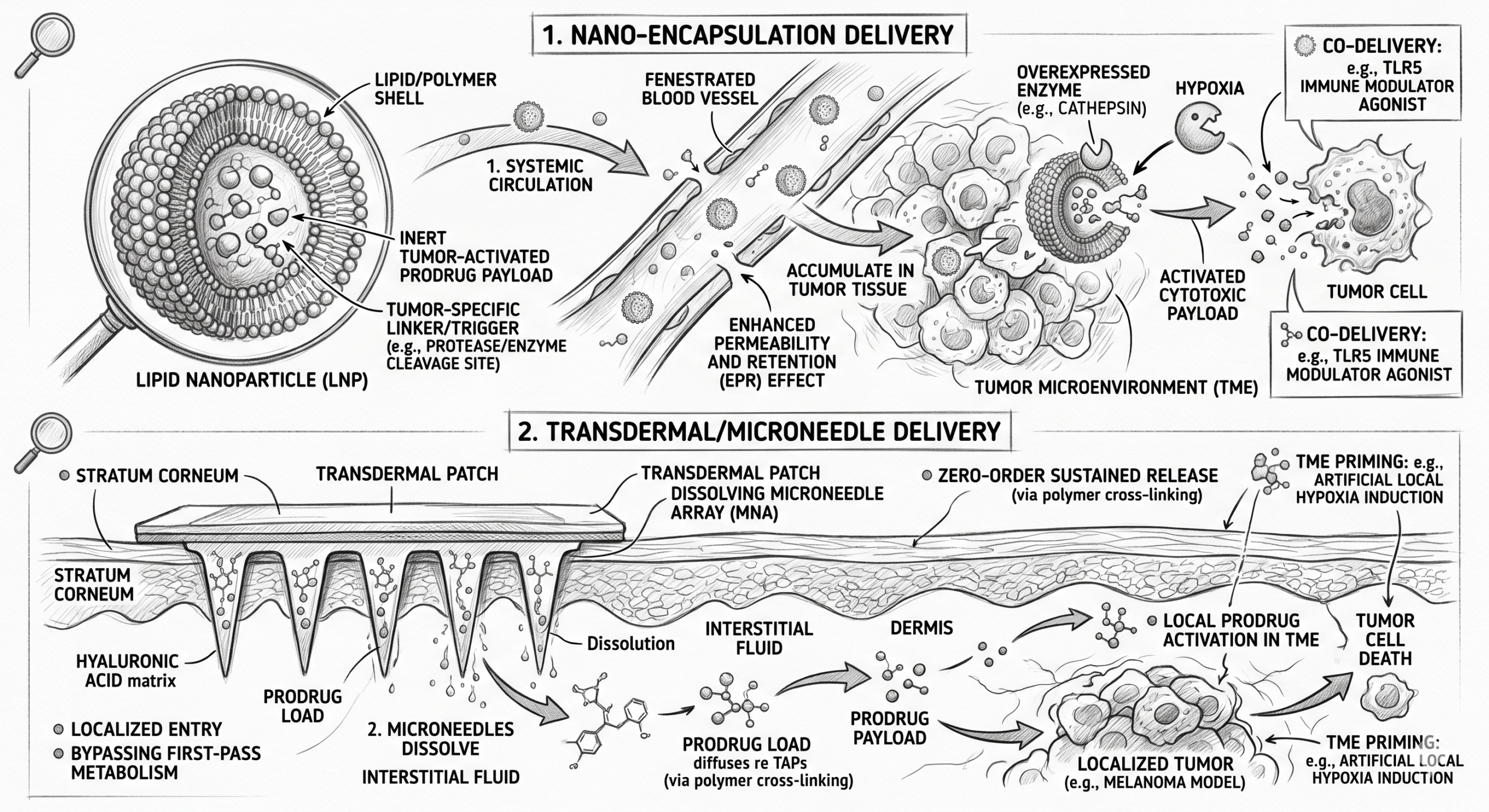
Nano-Delivery Systems
Lipid or polymer-based carriers could enhance hepatic uptake, enable stellate-cell targeting, and substantially improve oral bioavailability and liver distribution.
ECM-Targeted Retention
Given Lawsone’s affinity for protein structures, preferential retention in fibrotic tissue may be leveraged for site-specific, prolonged activity at the therapeutic target.
These formulation strategies are not merely supportive — they may become central to differentiation and intellectual property strategy, particularly in distinguishing a clinical asset from the raw natural product.
Translational Considerations
Development pathway:
preclinical to clinical
Lawsone is best classified as a late discovery / early preclinical candidate with strong mechanistic and in vivo antifibrotic evidence. It can be developed as a natural-origin small-molecule drug (NCE-like pathway) rather than a botanical mixture — enabling clear mechanism-of-action claims, stronger intellectual property positioning, and alignment with global regulatory expectations.
PK and bioavailability profiling
Full pharmacokinetic characterisation across species to establish exposure–efficacy relationships.
Dose–response and exposure–efficacy
Quantitative definition of the therapeutic window in antifibrotic models.
Validation in diet-induced NASH fibrosis models
Translation into clinically relevant dietary disease models for regulatory alignment.
Repeat-dose toxicology and genotoxicity assessment
Confirmatory safety package aligned with ICH guidelines for IND-enabling studies.
Formulation optimisation for liver targeting
Lead formulation candidate selection with demonstrable hepatic distribution and tolerability.
Broader Therapeutic Potential
Beyond the liver:
a platform antifibrotic molecule
The pathways modulated by Lawsone — particularly YAP signalling and fibroblast activation — are not confined to hepatic disease. The same mechanotransduction biology drives fibrosis across multiple organ systems, opening the possibility of meaningful therapeutic expansion.
Such cross-indication applicability positions Lawsone not merely as a single asset, but as a platform antifibrotic molecule — one whose core mechanism may be applied across a range of conditions where fibrosis is a driver of morbidity and mortality.
Conclusion
A new direction in
fibrosis therapeutics
Lawsone represents a convergence of natural-product pharmacology, modern mechanistic biology, and unmet clinical need in fibrosis-driven disease. Its ability to directly reprogramme stellate cells, inhibit YAP-mediated fibrogenesis, and reverse established fibrosis in preclinical systems places it within a rare and strategically valuable class of therapeutic candidates.
As the NASH field transitions from metabolic correction to true disease modification, molecules like Lawsone may define the next wave of innovation — where fibrosis is not merely managed, but actively reversed.
In the modern era of fibrosis therapeutics, the molecule that can actively reverse established disease — not merely slow its progression — represents the true frontier of clinical innovation.